2025 The Future of Tech is Human
2025 The Future of Tech is Human Jason h...
2025 The Future of Tech is Human
Jason here. Americans, in particular, have a love-hate relationship with technology. Is there an exciting tech-enabled future for us, or are we losing our humanity? I wanted to share my big picture view of where tech is going this year and why I think Flow is at the center of a positive tech convergence. I know it's a few minute read, but maybe by the end, maybe you'll want to be part of it too!
2025: The Future of Tech is Human
Watch a baby explore the world, and you’ll see humanity’s most fundamental learning process in action. They grasp objects, turn them over, and sometimes taste them. Through this tactile exploration, they build mental models of their environment. What if we could approach our data the same way?
For decades, our understanding of information has been mediated by abstract representations: charts, graphs, and dashboards that demand significant cognitive effort to decode. The convergence of augmented reality (AR), artificial intelligence (AI), and spatial computing marks a return to something much more intuitive. These technologies allow us to engage with information naturally, aligning with how our brains are wired to learn and solve problems in ways that feel deeply human.
Returning to Natural Understanding
When I founded a Montessori school years ago, I was struck by how children naturally progress from concrete exploration to abstract thinking. They learn to read not by memorizing symbols but by tracing sandpaper letters, connecting tactile sensations with their visual forms. This physical interaction lays the foundation for deeper understanding.
But in the professional world, we’ve replaced tactile exploration with dashboards, slides, and spreadsheets. We ask our brains to process data abstractly, losing the physical and spatial cues that help us understand and remember.
Our flat-world tech has forced us to encode the third dimension into abstract features like color or size. For example, when we look at geo-data on a flat map, we’re already using two dimensions to represent geographic space. To layer on more information, we often resort to making dots larger or smaller, or altering their color to show trends like population density or sales volumes.
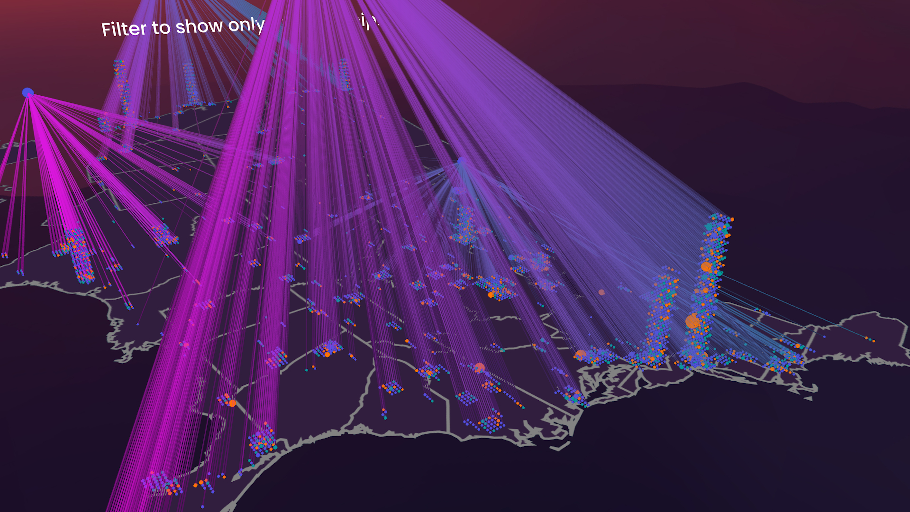
But with spatial computing, the third dimension can simply exist, represented directly in space. Dots can rise off the map to form towers, with height indicating value or frequency. For even more nuance, those towers can become “skyscrapers,” where every dot is something real: a transaction, a person, or a specific event. Every line can be a shipment or relationship. And with interactive popups, you can quickly drill down into the details behind each data point, making the abstract instantly concrete. Instead of mentally juggling complex relationships, the visualization allows your brain to focus on discovery and understanding.
Industry Momentum: Smart Glasses Arriving Soon
For years, extended reality felt like science fiction. Big VR headsets kept it on the fringes. Passthrough and Mixed Reality stepped us forward, but still only hinted at an everyday device. There is a new term, Smart Glasses, that much better captures the usability of the new form factor, and big tech is getting on board.
Google's Android XR creates the first operating system built from the ground up for spatial computing, with their Samsung collaboration putting AI at the center. Gemini doesn't just process commands – it understands context and intent, guiding users through complex tasks while keeping them connected to their physical environment. Google’s collaboration with Samsung will push devices into the consumer space.
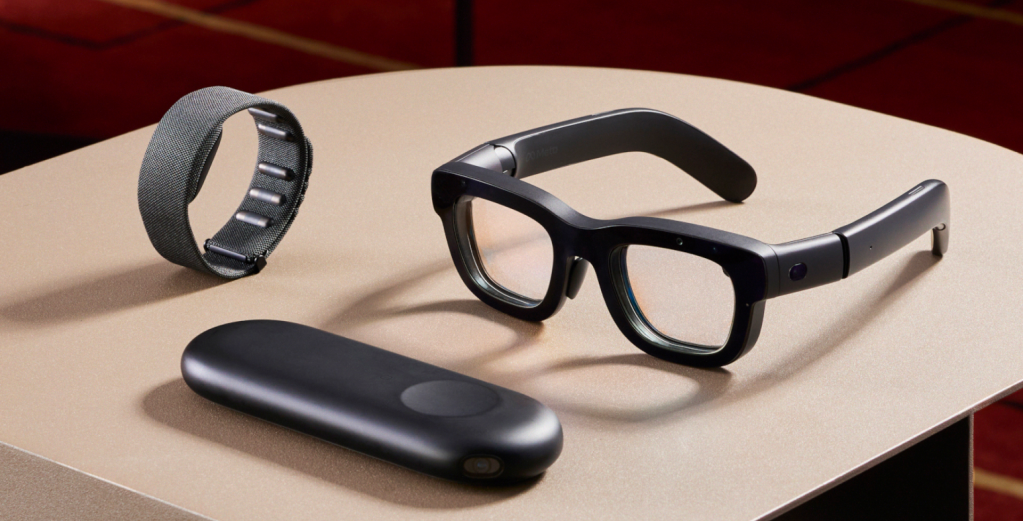
Meta’s Orion prototype
Meta's Orion project shatters previous technical barriers. Through breakthrough miniaturization, they've achieved what many thought impossible: powerful augmented reality in glasses you'd actually want to wear. Their expansive field of view transforms the AR experience to true environmental integration.
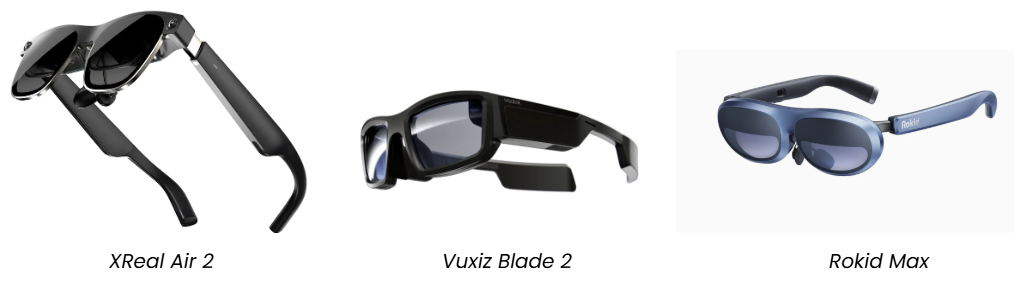
The momentum is building across the industry. Apple is working to enter the market with its own unique visions of ambient computing. Meanwhile, companies like XReal, Vuzix, and Rokid already offer capable smart glasses. A wave of innovative Chinese manufacturers stands ready to accelerate development and drive widespread adoption.
Paired with AI, these technologies help us focus on understanding rather than deciphering.
AI: The Natural Interface
Artificial intelligence elevates spatial visualization from static display to dynamic exploration. AI curates and validates data from diverse sources, but its core value lies in enabling natural interaction with complex information.
Levels of manipulation:
- Simple filtering and comparisons: examining data across time ranges or categories
- Light analysis: understanding correlations and normalizing comparisons
- Complex queries: identifying key drivers and predictive patterns
Users explore these levels through natural language. The technology adapts to our thought processes, rather than forcing us to adapt to it.
Collaborative Thinking in a Shared Space
Too often, data discussions are dominated by one person presenting their interpretation of abstract charts to others. This approach leaves little room for true collaboration. With Flow, we can step into a shared data space, where everyone can see, explore, and question the same information together. It isn’t about one person convincing the group—it is about the group discovering the truth together.
This is the kind of human connection that technology should foster: tools that bring us closer to shared understanding, not further away.
From Abstract to Intuitive: Application for Financial Data\
Financial analysis demonstrates this transformation. Technical indicators like Moving Average Convergence/Divergence (MACD) traditionally require interpreting multiple abstract lines on a chart. In spatial visualization, these patterns become three-dimensional structures that users examine from multiple angles, with AI highlighting significant patterns and potential decision points in real time.
Transcending Technology to Become More Human
At its best, technology disappears. It stops being something we notice and becomes an extension of our natural abilities. AR and AI have the potential to do this for our relationship with data. They allow us to move beyond decoding graphs and memorizing slides, instead engaging with information in ways that feel intuitive and human.
This isn’t about flashy visuals or new gadgets. It’s about restoring our ability to think deeply, collaboratively, and naturally.
And that’s a future I’m excited to help create and I believe will be wildly successful.