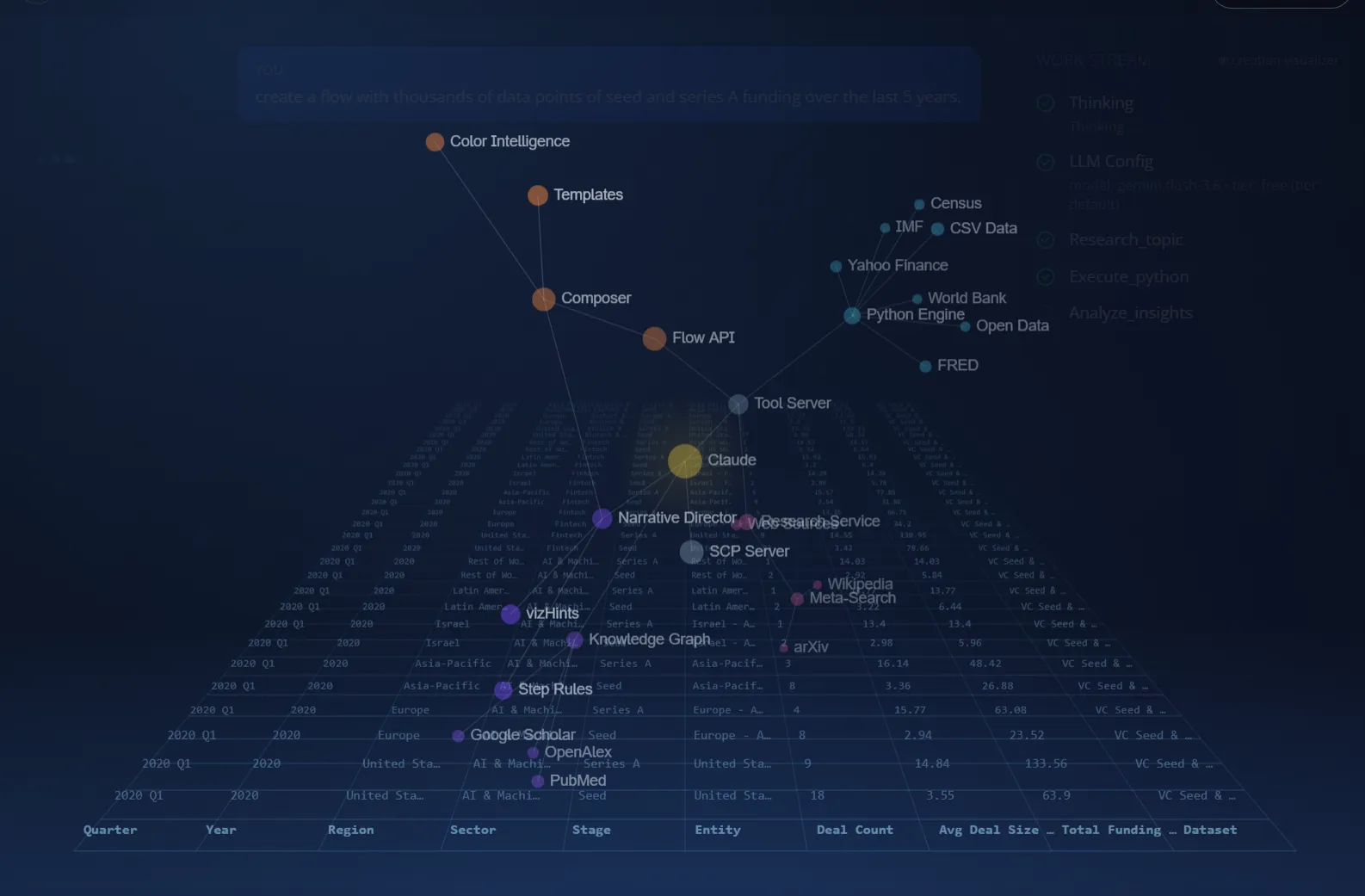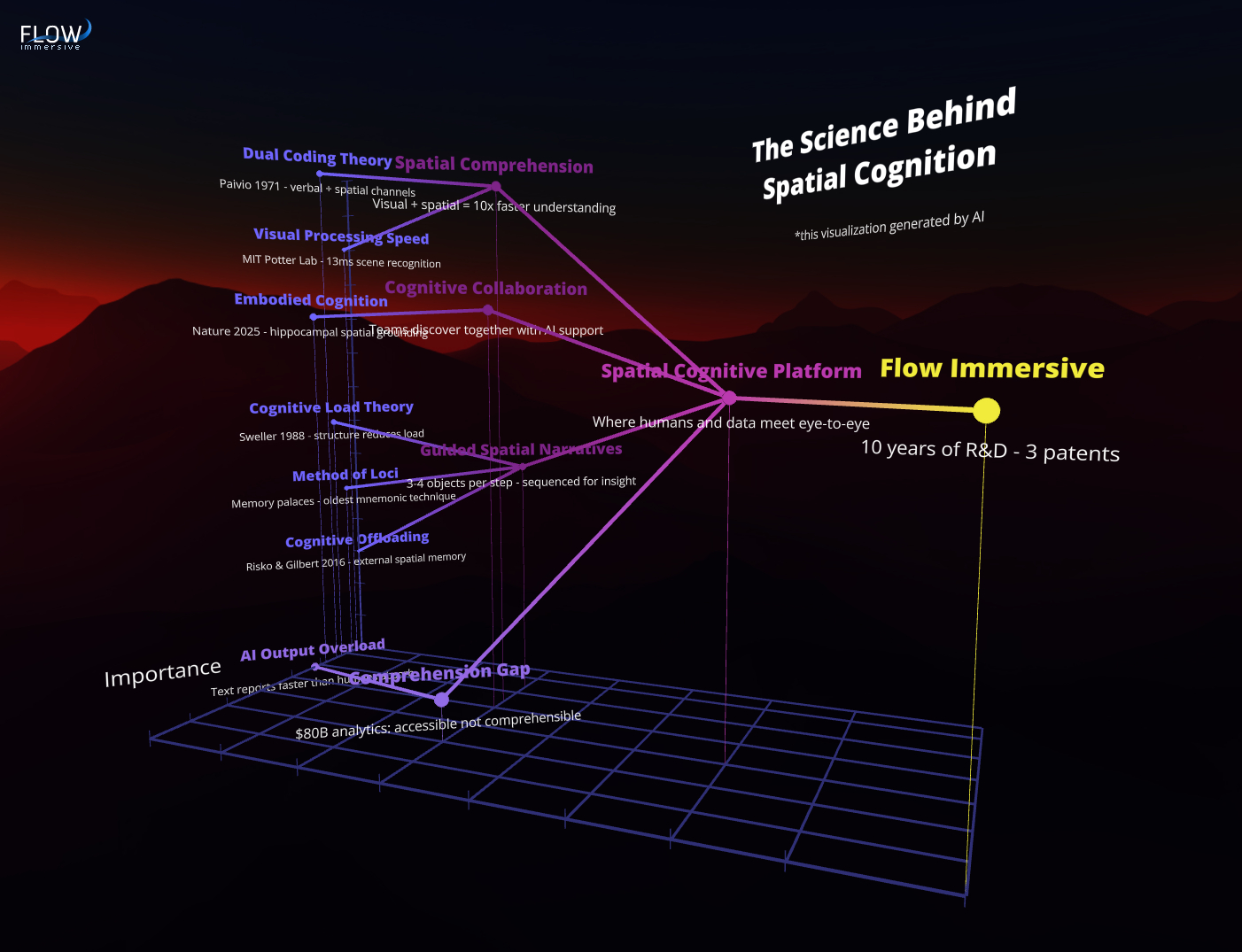
Flow Immersive is a Spatial Cognitive Platform. What’s that?
Flow Immersive is a spatial cognitive platform that turns data into guided, three-dimensional experiences that teams can explore together - in a browser, on smart glasses, or in augmented reality. Instead of reading a report or scrolling through a dashboard, you walk through the data. You point at what matters. Your team sees what you see and builds understanding together, with an AI assistant inside the experience helping you filter, highlight, and drill in.
Watch someone try to explain a complex idea using only words and you'll see them start pointing at the air. Drawing invisible diagrams with their hands. Unfortunately, only rarely reaching for a whiteboard. It's instinct - our brains want to place information somewhere in space before to make sense of it.
This isn't a metaphor. It's how human cognition actually works. And it has direct implications for how we should be building the interface between AI and humans.
What is a spatial cognitive platform?
A spatial cognitive platform turns data into guided, three-dimensional experiences that teams can explore together - in a browser, on smart glasses, or in augmented reality. Instead of reading a report or scrolling through a dashboard, you walk through the data. You point at what matters. Your team sees what you see and builds understanding together, with an AI assistant inside the experience helping you filter, highlight, and drill in.
The idea is grounded in fifty years of cognitive science research showing that spatial representation is how humans naturally process and retain complex information. A spatial cognitive platform operationalizes that science.
Why does spatial visualization work better than text for understanding data?
Human cognition runs on two parallel systems: verbal and spatial. Allan Paivio's dual coding theory (1971) showed that when information comes through both channels simultaneously, retention improves significantly. A 2025 IEEE systematic review of 16 studies confirmed that visual formats consistently outperform text in comprehension and cognitive load reduction (IEEE Conference Publication, 2025).
The speed difference is dramatic. MIT's Potter lab (2014) established that humans identify visual scenes in 13 milliseconds - roughly ten times faster than text reading at 100-200ms per word. This isn't a marginal improvement. It reflects a structural difference in how the brain processes visual versus textual information (Potter et al., Attention, Perception, & Psychophysics, 2014).
How does the brain process spatial information differently from flat visuals?
When we physically navigate spatial information - pointing at it, walking through it, rotating it - the hippocampus anchors it in memory through what researchers call "sensorimotor grounding." A 2025 Nature Human Behaviour paper connects this embodied interaction directly to reduced cognitive load when 3D visualization is present (Nature Human Behaviour, 2025).
This isn't limited to immersive environments. The Naval Research Laboratory confirmed that even interpreting a standard 2D graph engages spatial processing resources in the brain (Trickett & Trafton, Proceedings of the 29th Annual Cognitive Science Society, 2007). Spatial computing makes this implicit process explicit - and more powerful.
A 2023 Springer study further confirmed that 3D environments provide additional spatial cues that support cognitive processing beyond what 2D representations offer (Springer, 2023).
What is the comprehension gap, and why is AI making it worse?
The $80 billion analytics industry has made data accessible but not comprehensible. As AI generates multi-variable analyses, network relationships, and temporal patterns, the gap between data availability and human understanding is widening. The output arrives as text - reports, summaries, recommendations - and our brains have to work to translate words into mental models.
The defense community names this problem explicitly. JADC2 doctrine calls for "decision dominance through reduced cognitive workload" (JADC2 Strategy, U.S. DoD, 2022). The Air Force Research Lab frames it as "increasing combat power while decreasing cognitive workloads" (AFRL Warfighter Interactions & Readiness Division, 2024). A 2025 GAO review of CJADC2 found that data visualization capability still needs further progress (GAO-25-106454, 2025).
AI explainability research points the same direction. A 2025 arXiv paper bridges immersive XAI and spatial visualization (arXiv, 2025). A 2025 AGILE conference paper frames spatial visualization as the interface between AI models and human-interpretable insights (AGILE, 2025). Frost & Sullivan's 2025 analysis of the analytics market echoes this convergence (Frost & Sullivan, 2025).
The highest-bandwidth communication between an AI and a human isn't text. It's visual understanding.
Does making data 3D always improve comprehension?
No, and this is the part most people get wrong. Unstructured 3D actually makes things worse.
Cognitive Load Theory (Sweller, 1988) predicts that 3D representation can either reduce or increase cognitive load depending on design. Throwing data into three dimensions without guidance increases extraneous load and makes comprehension harder (Cognitive Science, 12(2), 1988). A 2026 study in Springer/Medical Education confirmed this dual nature of 3D in learning contexts (Springer/Medical Education, 2026).
The distinction is between "making things 3D" and designing guided spatial narratives - sequenced, step-by-step experiences that respect working memory limits. Baddeley's research on the visuospatial sketchpad tells us the brain handles about 3-4 objects per view before it starts dropping information (Science, 255(5044), 1992). Each step in a spatial narrative needs to stay within that window.
How does the method of loci, or memory palace, relate to spatial data visualization?
The method of loci is the oldest known memory technique - you place information in spatial locations and navigate between them. A 2025 arXiv paper on cognitive load-driven VR memory palaces shows that spatial environments tailored to cognitive profiles improve retention (arXiv, 2025).
Risko and Gilbert (2016) formalize this as "cognitive offloading" - humans naturally use external spatial representations to reduce internal cognitive burden (Trends in Cognitive Sciences, 20(9), 2016).
A well-designed spatial data narrative is structurally identical to a memory palace. Each step places data in a location, and navigation creates the episodic memory trace that makes understanding persist. This is why people remember spatial data experiences long after the meeting ends, while text-based reports fade within hours.
What is cognitive collaboration, and why does it matter for teams?
Cognitive collaboration is what happens when a team gathers in a shared spatial data environment - with avatars and laser pointers - and explores data together with an AI assistant. It maps directly to how humans evolved to make group decisions: gathered around a shared representation, pointing at the same objects, building collective understanding.
What makes this more than a shared screen is the AI inside the experience. Colleagues can ask the AI to filter, highlight, re-sort, or drill into the data while everyone watches the spatial environment respond. The group doesn't just view a static picture together - they navigate and grapple with the data together, guided by AI that manipulates it on command.
The shift from "one person presents their interpretation" to "the group discovers together with AI support" is where human experience compounds. Learning happens in the act of exploring together, not in reading a summary afterward.
How does Flow Immersive's platform work?
Flow Immersive is the ‘spatial cognitive platform’ - where humans and data meet eye-to-eye. No other competitors are working in this space. We close the comprehension gap not with better charts but with spatial cognition: guided, step-by-step experiences where data becomes a place for understanding.
We've invested 40+ person-years into cross-modal UX across 3D, AI, AR, and collaboration. The design methodology directly operationalizes the cognitive science: dual coding (data re-encoded spatially), controlled cognitive load (step-by-step narrative with 3-4 elements per view), and embodied interaction (spatial navigation and pointing in shared environments). From the beginning, the platform has been built with brain science front of mind.
The platform runs in any browser today. Smart glasses are the amplifier, not the dependency. Flow runs across desktop, mobile, and smart glasses via WebXR, and on XREAL glasses via Unity-based app. With smart glasses projected to ship 30M+ units by 2027, Flow is positioned at the convergence of spatial computing and AI.
Through MCP (Model Context Protocol) integration, Flow is the spatial output layer for AI. Every AI assistant that can call an MCP tool - Claude, ChatGPT, Gemini - can now produce spatial data narratives through Flow, embedded in every AI conversation.
References
Paivio, A. (1971). Imagery and Verbal Processes. Holt, Rinehart and Winston.
Sweller, J. (1988). Cognitive Load During Problem Solving. Cognitive Science, 12(2).
Baddeley, A.D. (1992). Working Memory. Science, 255(5044), 556-559.
Trickett, S.B. & Trafton, J.G. (2007). The Use of Spatial Cognition in Graph Interpretation. Proceedings of the 29th Annual Cognitive Science Society.
Potter, M.C. et al. (2014). Detecting meaning in RSVP at 13ms per picture. Attention, Perception, & Psychophysics.
Risko, E.F. & Gilbert, S.J. (2016). Cognitive Offloading. Trends in Cognitive Sciences, 20(9).
Kennada, A. (2019). Category Creation: How to Build a Brand that Customers, Employees, and Investors Will Love.
JADC2 Strategy (2022). Joint All-Domain Command and Control. U.S. Department of Defense.
Springer (2023). Spatial processing and 3D visualization environments.
AFRL (2024). Warfighter Interactions & Readiness Division: cognitive research for decision superiority. Air Force Research Laboratory.
IEEE Conference Publication (2025). Data Stories and Cognitive Load: A Systematic Review of the Picture Superiority Effect.
Nature Human Behaviour (2025). Embodied cognition and cognitive load theory.
GAO-25-106454 (2025). Review of CJADC2 efforts. U.S. Government Accountability Office.
arXiv (2025). Immersive explainability: bridging XAI and spatial visualization.
arXiv (2025). Cognitive load-driven VR memory palaces.
AGILE Conference (2025). Spatial visualization as the interface between AI models and human-interpretable insights.
ResearchGate (2025). Spatial computing and AI convergence analysis.
Frost & Sullivan (2025). Analytics market and spatial computing convergence.
Springer/Medical Education (2026). Cognitive load and 3D representation in learning contexts.
Equal Ventures/Bessemer Cloud Index. Platform vs. tool company valuation multiples.